MCP2551 replacement: MCP2561, SN65HVD230 and SN65HVD251 compared (2026)
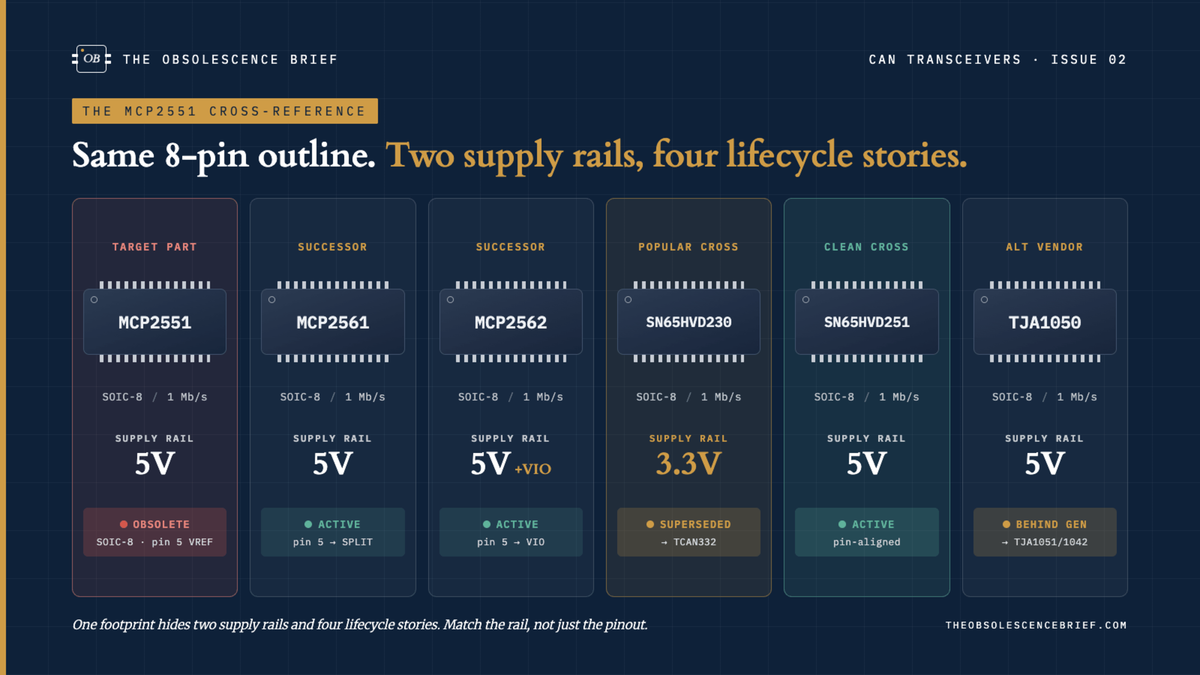
The MCP2551 replacement, and the two problems the cross-reference hands you
The MCP2551 CAN transceiver is obsolete in its SOIC package, and the cross that looks like it solves the problem sets up two more. Same 8-pin outline, very different parts: one is 3.3V, two change the function of pin 5, and one popular cross is itself already being retired.
Status // The part in question
Lifecycle status
The MCP2551 is obsolete in the SOIC-8 package (-I/SN) per distributor lifecycle flags. The PDIP-8 has historically shown as Active or NRND, so confirm the exact package you use. Microchip publishes a first-party migration note, TB3101 "MCP2551 to MCP2561 Migration."
Current stock and any last-time-buy window are dated data for the email, not this page.
Candidates // Why these five
The candidate set
The parts engineers actually cross-shop for the MCP2551, each with its own fit-catch to validate in your design:
Catch — pin 5. Same footprint, but pin 5 changes from VREF to SPLIT (2561) or a separate logic supply VIO (2562). Per Microchip's own TB3101, review the differences before assuming a straight swap.
Two catches — rail and lifecycle. It is a 3.3V part (MCP2551 is 5V), so supply and logic interface change. It is also being retired: TI names TCAN332 as successor and SN65HVD230D reads Obsolete at distribution — standardizing on it designs in a second EOL.
Catch — electrical, not lifecycle. The clean active 5V cross: pin-aligned and in production. Validate bus common-mode (−7 to +12V) and fault tolerance (±36V) against your network; pin alignment does not establish network compatibility.
Catch — family and generation. A functional 5V transceiver, still in production, but positioned behind NXP's newer TJA1051/1042 generation and from a different device family. Confirm its status and behavior before crossing to it.
Parametrics // Side by side
The comparison
| MCP2551 | MCP2561 | MCP2562 | HVD230 | HVD251 | TJA1050 | |
|---|---|---|---|---|---|---|
| Lifecycle | Obsolete | Active | Active | Superseded | Active | Behind gen |
| Supply V | 4.5–5.5 | 4.5–5.5 | 4.5–5.5 +VIO | 3.3 | 5 | 4.75–5.25 |
| Pin 5 | VREF | SPLIT | VIO | Vref | VREF | Vref |
| Footprint | PDIP/SOIC-8 | SOIC-8 | SOIC-8 | SOIC-8 | SOIC-8 | SOIC-8 |
| Data rate | 1 Mb/s | 1 Mb/s | 1 Mb/s | 1 Mb/s | 1 Mb/s | 1 Mbaud |
Only the SN65HVD230 carries a retirement flag of its own; TI names the TCAN332 as its pin-for-pin successor. Lifecycle flags are distributor/vendor-reported, not independently audited.
The gap // What a parametric search hides
What the cross-reference misses
The footprint match hides three things
A parametric search for "high-speed CAN transceiver, 1 Mb/s, SOIC-8" returns all of these as matches. What it does not surface: that the SN65HVD230 is 3.3V and already superseded, that MCP2561/2562 change pin 5, and that the TJA1050 sits behind a newer NXP generation. The footprint match hides the supply rail, the pinout function, and the candidate's own lifecycle standing — so the obvious cross can be a 3.3V mismatch or a design-in of a part on its way out.
Decision // Fit to your design
How to choose
No single winner; a fit to your design and program. Both registers:
Checklist // Before you commit
Before you buy
FAQ // Frequently asked
Frequently asked questions
MCP2551 or SN65HVD230?
The SN65HVD230 is a common cross, but it is 3.3V (the MCP2551 is 5V) and it is being superseded by the TCAN332. Treat it as a candidate to validate, and look at its successor rather than the part itself.
Is the SN65HVD230 still active?
TI lists a newer version (TCAN332) as the pin-for-pin replacement, and the SN65HVD230D shows Obsolete at distribution. Confirm the exact orderable you need before designing it in.
Which cross is a clean active 5V part?
The SN65HVD251 is pin-aligned with the MCP2551 and in production; validate its bus common-mode (−7 to +12V) and fault (±36V) ratings against your network. A candidate to validate, not a guaranteed drop-in.
MCP2561 vs MCP2551, what changed?
Same footprint, but pin 5 goes from VREF to SPLIT; see Microchip TB3101 for the full difference list.
Signals // Watch List
The Watch List
Two things to carry forward
The obvious cross can be aging too
The most-referenced 3.3V cross, the SN65HVD230, is itself being replaced — TI names the TCAN332 successor and the SN65HVD230D reads Obsolete at distribution. Check a candidate's own lifecycle standing before crossing to it.
The footprint spans two supply rails
The same 8-pin CAN transceiver outline covers 3.3V (SN65HVD230) and 5V (MCP2551, SN65HVD251) parts, so a footprint match can still be a rail mismatch. Confirm the supply rail against your design.