Serial and RTC obsolescence: the class-level traps and what to verify
Why RTCs are a silent obsolescence risk
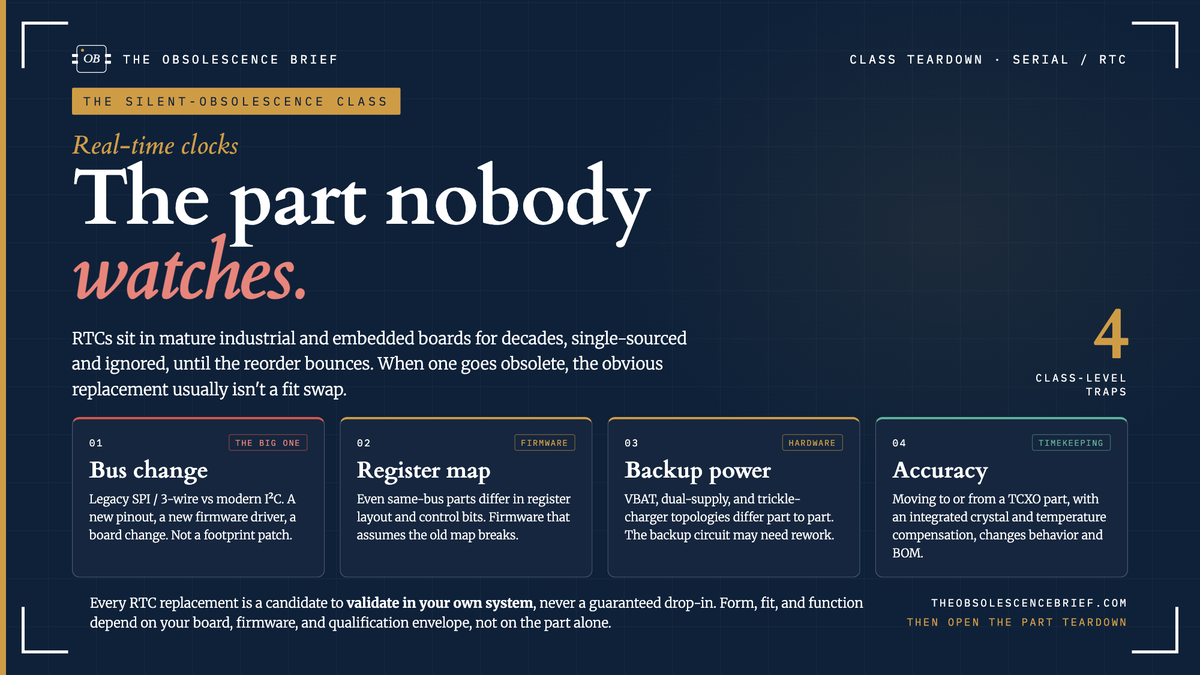
The real-time clock is the part nobody worries about until the reorder bounces. RTCs have been in mature industrial, instrumentation, and embedded boards for decades; they are often single-sourced and rarely receive the lifecycle attention an MCU does. When one becomes obsolete, the obvious replacement is usually not a good fit.
The class-level traps (what bites on an RTC migration)
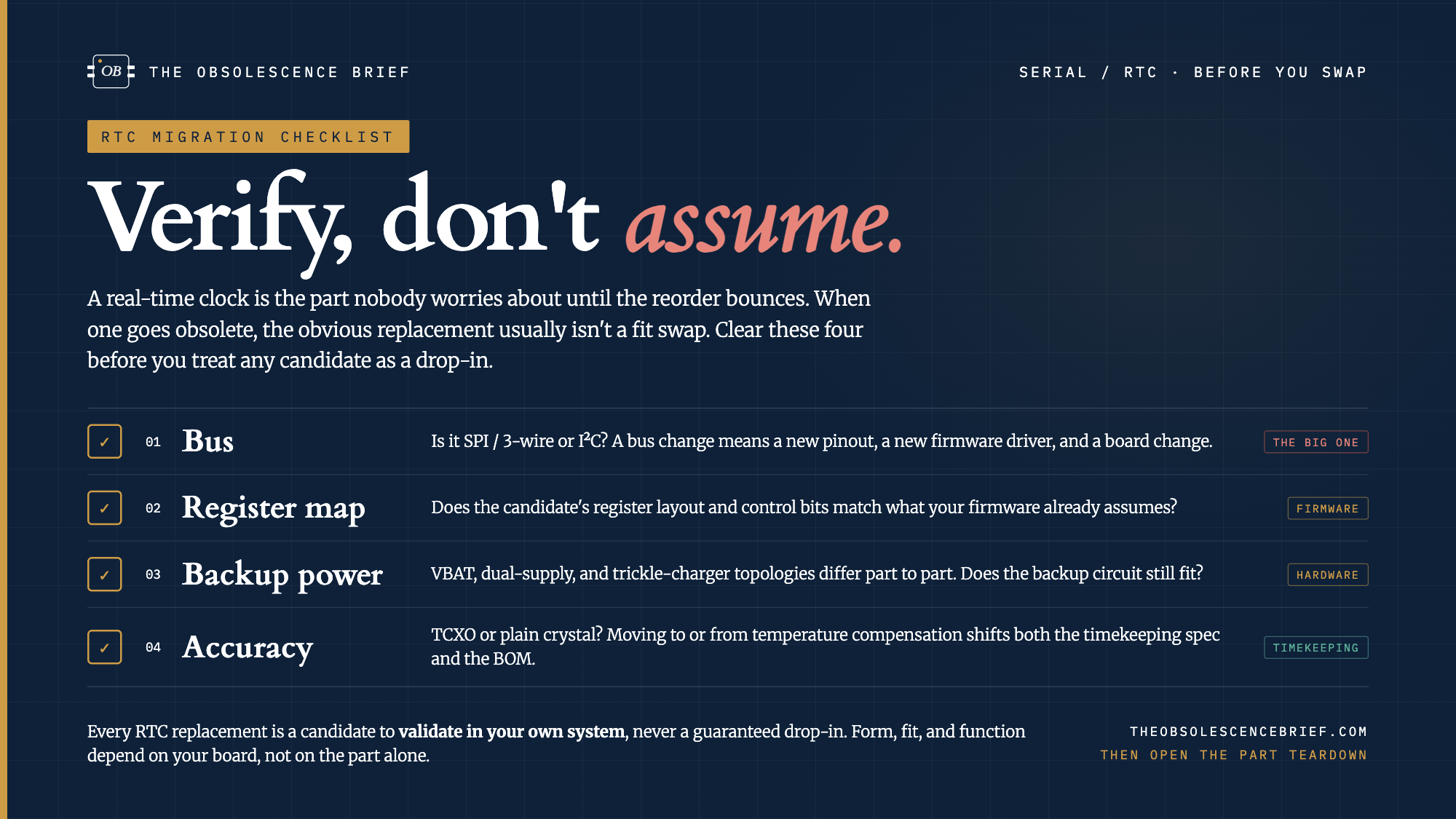
- Bus change (the big one). Many legacy RTCs are SPI or 3-wire; modern parts are typically I2C. Different bus means new pinout, a new firmware driver, and a board change. Not a footprint patch.
- Register map. Even same-bus parts differ in register layout and control bits, so firmware that assumes the old map breaks.
- Backup power topology. Dual-supply, VBAT, and trickle-charger arrangements differ part to part; the backup circuit may need rework.
- Accuracy. Moving to or from a TCXO part (integrated crystal, temperature compensation) changes timekeeping behavior and BOM.
Every RTC replacement is a suggested candidate to validate in your own system, never a guaranteed drop-in. Form, fit, and function depend on your board, firmware, and qualification envelope, not on the part alone.
Teardowns in this class
- DS1305 (Maxim) - obsolete SPI/3-wire RTC: the SPI-vs-I2C trap in detail, with candidate replacements and what to verify.
- More teardowns added as each issue ships.
How to use this page
Start here for the class-level traps, then open the specific teardown for your part. If your exact part is not yet covered, the checks above still apply: confirm the bus, the register map, the backup topology, and the accuracy spec before you treat any candidate as a swap.