DS1305 EOL: DS3234 Replacement Risks and What to Verify (2026)
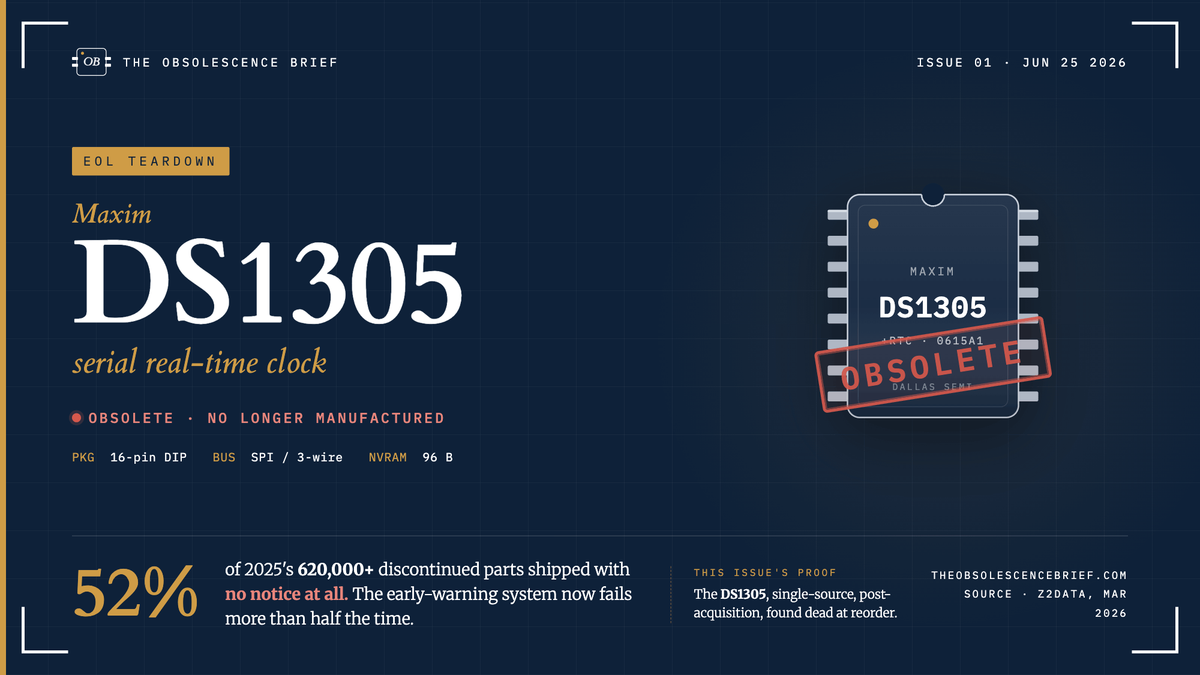
Issue 01 | The Obsolescence Brief | June 25, 2026
In 2025, manufacturers discontinued more than 620,000 electronic parts. That is up nearly a third in two years. And here is the part that should keep you up at night: 52 percent (323,286 out of 621,909 parts) came with no product change notice at all, up from the 25-30 percent range seen in 2023. The early-warning system is failing in more than half of all obsolescence events.
This issue: the Maxim DS1305 serial real-time clock is already over the line. First, the DS1305 teardown and what the replacement path actually looks like. Then, the six ways out of an obsolescence event, and what each one actually costs you. Welcome.
EOL Teardown: Maxim DS1305 serial real-time clock
Status: Obsolete. DigiKey lists the DS1305 lifecycle as obsolete, no longer manufactured, with only remnant and independent-distributor stock left. (Confirmed 2026-06-24. Re-check live stock the day you order, the number only goes down.)
What it is: A jellybean serial RTC that has sat quietly in mature industrial and instrumentation boards for two decades. It keeps time and date, carries 96 bytes of NV RAM, runs two programmable time-of-day alarms, and includes a programmable trickle charger with a VBAT backup input.
Why it matters: This is exactly where silent obsolescence bites. Nobody worries about the real-time clock until the reorder bounces and the line stops. And the DS1305 hides a trap the cross-reference tools wave right past: it is an SPI and 3-wire part (the SERMODE pin picks the mode). The "modern RTCs" the forums will point you to, the DS3231, DS1307, and PCF8523, are I2C. That is not a footprint you patch. It is a different bus: new pinout, new firmware driver, a board change, and a requalification.
Suggested replacements (validate in YOUR system, not pound for pound):
These are candidates to evaluate, not drop-ins. Form, fit, and function depend on your design: the bus, the register map your firmware assumes, the board, and the qualification envelope. The same part can pass in one system and fail in another. Validate each in your own design.
| Candidate | Why consider it | Why it is NOT a drop-in |
|---|---|---|
| DS3234 (SPI) | Active (Production); stays on SPI; TCXO and integrated crystal; 256 bytes SRAM | Different pinout, package, and register map; 256B SRAM vs 96B; firmware and board rework. See DS3234 traps below. |
| DS3231 / DS1307 / PCF8523 (I2C) | What the forums suggest first | Different bus entirely: new pinout, new driver, board change. A function swap, not a fit swap. |
| Continuation / aftermarket (same part) | Authentic DS1305 if requalification is too costly | Price premium, finite supply. Confirm authenticity and traceability of the source. |
DS3234 traps (read before you order):
- Temperature suffix. DS3234S = commercial (0 to +70C); DS3234SN = industrial (-40 to +85C). The DS1305 industrial range was also -40 to +85 °C. Confirm your thermal envelope against your suffix.
- CE polarity. The DS1305 uses an active-HIGH chip enable. Verify the DS3234 chip select polarity against its datasheet before reusing any legacy driver logic. Assuming it matches is a common mistake that produces a dead bus.
- Power budget. The DS3234's integrated TCXO increases both active and backup current draw (Icc and Ibat) compared to the discrete DS1305. Re-calculate the life of your backup battery or supercapacitor from scratch using the DS3234 datasheet values. Do not carry over DS1305 figures.
- 3-wire trap. The DS3234 is SPI-only. It does not support 3-wire mode under any configuration. If your board has SERMODE tied to GND (3-wire mode), the DS3234 is not a viable path without a full driver rewrite.
The honest call: If the design is frozen around the DS1305's SPI interface and register map, the cheapest, safest path is typically an authentic continuation part or a last-time buy that covers your entire remaining build and spares. Avoid switching to a "modern" I2C RTC, which will require both a firmware rewrite and a board redesign. Only consider a TCXO part like the DS3234 if you already plan a redesign. No matter the replacement, always treat this as a full requalification effort, not a simple substitution.
Further reading
Before you buy: confirm remaining stock the day you order; confirm your firmware's assumed interface and register map against the candidate; confirm pinout and package on your exact ordering suffix (the DS1305 ships in 16-pin DIP and 20-pin TSSOP only; there is no SO package); check the SERMODE pin state on your board (SERMODE tied to GND = 3-wire mode, SERMODE tied to VCC = SPI mode, per the DS1305 datasheet) before selecting any SPI-only replacement; verify chip select polarity on any candidate against its own datasheet (the DS1305 CE is active-HIGH, which is not universal); re-calculate your backup power budget using the candidate's actual Ibat from its datasheet, not the DS1305 figures; and verify the authenticity and traceability of any aftermarket source.
The Main Piece: the six ways out of an obsolescence event, ranked by actual cost
When a manufacturer discontinues a part you depend on, you have exactly six options. Every "strategy" you have ever read is one of these six, or a combination. Here they are, cheapest to most painful, with the costs the brochures leave out.
1. Use existing stock. This is the lowest up-front cost, but deceptively risky. Using stock only delays the inevitable, and the real cost is complacency: the organization relaxes, exhausts the buffer, and risks costly disruption later when stock runs dry without a plan. If you pursue this, do so deliberately, and set a deadline to decide on the next step before inventory depletes.
2. Last-time buy. Buy enough to cover remaining production and sustainment, then store it. Costs: moderate cash outlay now, then three hidden types later: inventory carrying cost (ties up capital and incurs storage expenses), forecasting risk (order too few and you are short; too many, and you write off the excess), and shelf life (electrolytics, some ICs, and moisture-sensitive parts degrade over time). A last-time buy is simply a forecast turned purchase order. Treat the demand number with suspicion.
3. Approved alternate or substitute. Substitution may seem economical if a true drop-in exists, but often incurs unpredicted costs: redesign time, firmware changes, qualification testing, and potential failures. Budget for complete requalification studies, not just unit cost, as discrepancies in pinout, software, or specs can demand significant investment.
4. Authorized aftermarket source. Companies like Rochester Electronics continue to remanufacture obsolete devices using original tooling or dies. These sources provide authentic parts with traceability, critical for brutal requalification scenarios such as flight hardware, medical equipment, or anything that demands recertification. Costs are higher per part, and coverage is limited, but when applicable, it can be the most cost-effective route after accounting for the often substantial expense of a redesign.
5. Emulation. For parts that are truly gone, a functional equivalent is built to match form, fit, and function. Higher non-recurring cost, longer lead time, niche availability, but it can save a system with no other path. A specialist's tool, not a first move.
6. Redesign. This is the most expensive and time-consuming path. Costs include engineering labor, new tooling, testing and validation, regulatory recertification, and project delays, often exceeding several hundred thousand dollars in complex regulated products. However, when completed, it shifts future cost curves sharply downward by restoring part availability and operational continuity.
The decision lens. Before you fall in love with any option, answer three questions. How long must you sustain this? How many units, over what schedule? And what is the requalification burden? A short horizon and cheap requal open up stock, last-time buy, and alternates. A long horizon and a punishing requal point you toward aftermarket, emulation, or redesign. The teams that handle obsolescence well make decisions deliberately and early, with requalification costs in the room from day one.
The Watch List
- Silent EOL is now the majority, not the exception. Of the 620,000-plus parts that went obsolete in 2025, 52 percent shipped without a PCN, up from 25-30 percent previously. If you are not on a manufacturer's direct notice list, you find out when you reorder, and the stock is gone. (Z2Data)
- The mature-node squeeze is real. Foundries are shifting mature-node capacity toward AI logic and high-bandwidth memory, which ages out the older analog and mixed-signal parts that ride those nodes. If your part is built on an old node, its clock is running. (Z2Data, PartAnalytics)
- The EU PFAS restriction keeps advancing. ECHA's risk-assessment committee adopted its final opinion in March 2026. The socio-economic committee published a draft opinion in March 2026 and closed its public consultation in May 2026; its final opinion is expected by late 2026. Commission legislation (with a vote by EU member states and the European Parliament) is currently anticipated in 2027 or 2028, with the restriction entering into force no earlier than 2029. Timelines have already slipped once; treat these as floors, not hard dates. Electronics and semiconductors are in scope, likely with exemptions. Regulatory obsolescence is still obsolescence, and PFAS reaches coatings, connectors, and subcomponents with little warning. (ECHA, Arnold & Porter)
- Consolidation aftershocks. Post-acquisition catalogs are where jellybean parts quietly go obsolete. The DS1305, a legacy Maxim part now under Analog Devices, is this month's proof. If you carry single-source parts from a catalog that recently changed hands, check their status before they do. (DigiKey, Analog Devices)
One Resource
TrustedParts.com (free). Run by ECIA, it covers 25 million-plus part numbers with lifecycle and supply-risk flags, and it has the most permissive terms of any free source. A solid first stop to check a part's status without an enterprise subscription. It is a status and availability checker, not a PCN workflow or lifecycle-forecasting platform; for that layer, you need a paid tool.
That is issue 01. If a colleague keeps a product alive past its parts' expiration date, forward this to them. They will get it.